Should You Buy Ready-Made Software or Build Custom Software?
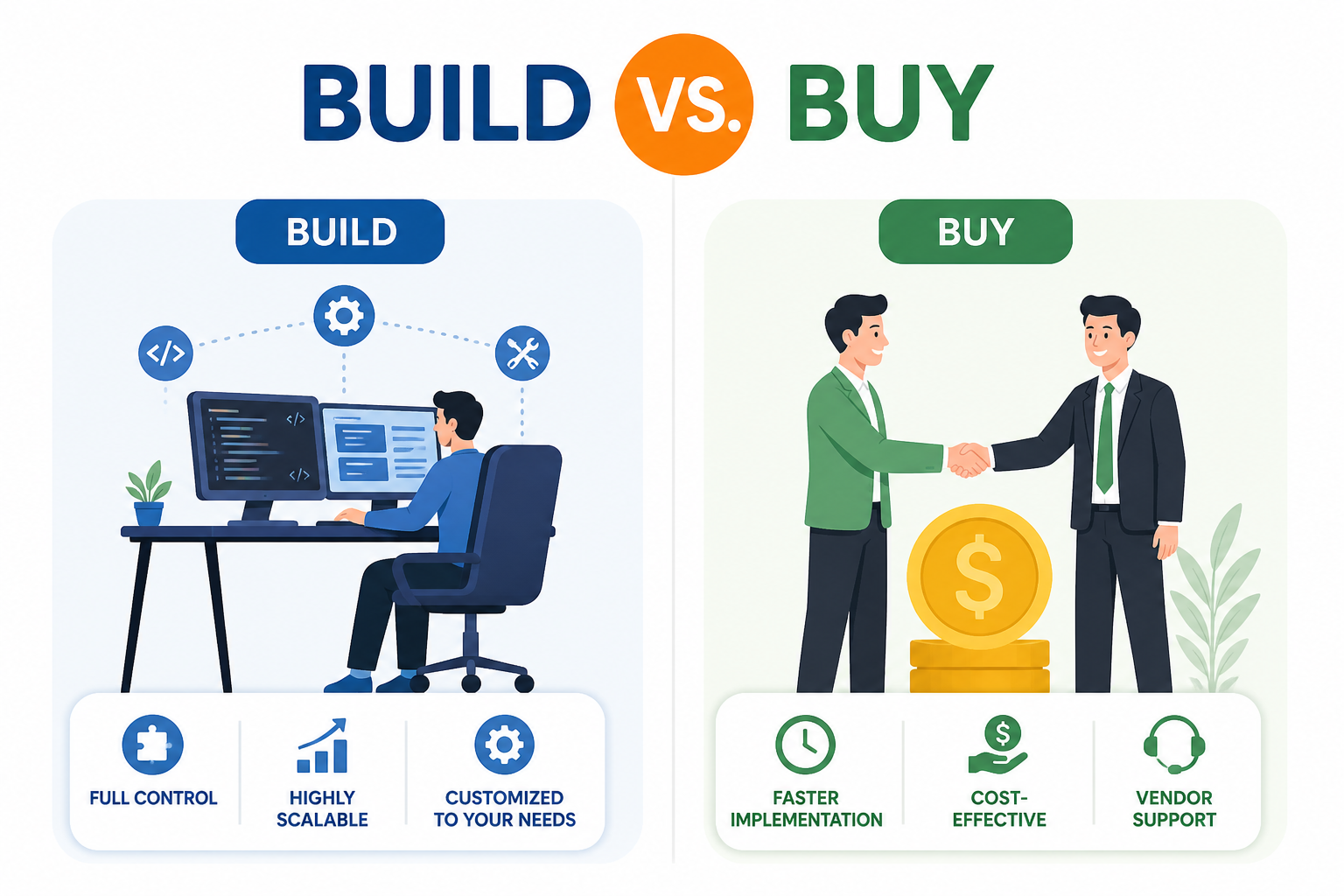
Choosing the right software can have a major impact on how efficiently your business operates. Today, businesses generally have two options: buy ready-made software or build custom software specifically for their needs.
Ready-made software is usually faster and cheaper to start with, while custom software offers greater flexibility and control. But which option is right for your business?
The answer depends on your budget, business processes, growth plans, and how closely existing software matches your requirements.
What Is Ready-Made Software?
Ready-made software, also known as off-the-shelf software, is a product developed for a broad range of businesses.
Examples include accounting software, CRM platforms, POS systems, project management tools, inventory systems, and SaaS platforms.
Instead of developing the software yourself, you subscribe to or purchase an existing solution and configure it for your business.
Advantages of Ready-Made Software
1. Lower initial cost
You don't need to pay for an entire software development project. Many ready-made solutions use monthly or yearly subscription models.
2. Faster implementation
Most ready-made software can be configured and used within a short period of time.
3. Regular updates
The software provider generally handles security updates, bug fixes, and new features.
4. Proven solution
Popular software products are already being used by many businesses, which can reduce the risks associated with adopting a new system.
Disadvantages of Ready-Made Software
The biggest limitation is that your business has to work within the software's existing features.
You may encounter:
-
Features you don't need
-
Missing features you actually require
-
Limited customization
-
Restrictions on workflows
-
Integration limitations
-
Vendor dependency
-
Increasing subscription costs
If your business has unique processes, these limitations can become frustrating over time.
What Is Custom Software?
Custom software is developed specifically for a particular business, organization, or business process.
Instead of changing your business processes to fit existing software, the software is designed around your actual requirements.
For example, a growing pharmacy business might need a system that combines:
-
Inventory management
-
Sales and POS
-
Purchase management
-
Supplier management
-
Expiry tracking
-
Accounting
-
Customer management
-
Reports
-
Multiple branches
-
Role-based access
If existing software cannot handle these requirements properly, custom software may be a better option.
Advantages of Custom Software
1. Built around your business
The software can be designed according to your actual workflows and requirements.
2. Greater flexibility
You can add custom features, integrations, dashboards, reports, and automation that aren't available in standard software.
3. Better scalability
As your business grows, the system can evolve with it.
4. Integration with existing systems
Custom software can be developed to communicate with payment gateways, accounting systems, APIs, websites, mobile applications, CRMs, ERPs, and other business tools.
5. More control
Depending on the development arrangement, you can have greater control over the software, database, infrastructure, and future development.
Ready-Made Software vs Custom Software
The main differences can be summarized as follows:
| Factor | Ready-Made Software | Custom Software |
|---|---|---|
| Initial Cost | Usually lower | Usually higher |
| Implementation | Fast | Takes more time |
| Customization | Limited to available options | Highly flexible |
| Scalability | Depends on provider | Can be designed for your growth |
| Features | General-purpose | Business-specific |
| Integrations | May be limited | Can be developed as required |
| Maintenance | Usually handled by vendor | Requires development/maintenance |
| Control | Limited | Greater control |
| Best For | Standard business processes | Unique or complex processes |
When Should You Choose Ready-Made Software?
Ready-made software is often the better choice when your business processes are relatively standard.
Consider an off-the-shelf solution if:
-
You need software quickly
-
Your requirements are simple
-
Your budget is limited
-
Existing software already provides most of the features you need
-
You don't require complex integrations
-
You are comfortable with the provider's pricing model
-
You don't need extensive customization
For example, a small business that only needs basic invoicing and expense tracking may not need a custom accounting system.
In that situation, purchasing an existing solution can be more practical.
When Should You Build Custom Software?
Custom software becomes more attractive when existing solutions cannot properly support your business.
You may want to consider custom development if:
-
Your business has unique workflows
-
Existing software requires too many workarounds
-
You need specialized features
-
You require multiple third-party integrations
-
You operate multiple branches or business units
-
You need advanced automation
-
Your business is growing rapidly
-
You need complete control over specific processes
-
You want to create a software product for your customers
For example, an e-commerce company might require a system connecting its website, inventory, courier providers, payment gateways, accounting, CRM, and marketing platforms.
If no existing product handles the entire workflow efficiently, custom software can provide a more suitable solution.
How Much Does Custom Software Cost?
One of the biggest concerns about custom software is development cost.
There is no single fixed price because the cost depends on factors such as:
-
Number of features
-
User roles
-
Design requirements
-
Web or mobile platforms
-
Third-party integrations
-
Database complexity
-
Security requirements
-
Automation requirements
-
Reporting and analytics
-
Development time
-
Ongoing maintenance
A small internal business application can be relatively simple, while a complete ERP, CRM, e-commerce platform, or SaaS product can require significantly more development.
Instead of comparing only the initial price, businesses should consider the total cost of ownership over several years.
Don't Compare Only the Initial Price
A common mistake is to compare the subscription price of ready-made software with the development cost of custom software.
For example, a ready-made solution might cost $50 per month, while custom software could require thousands of dollars initially.
At first glance, the ready-made solution appears much cheaper.
But consider the long-term costs:
Ready-made software:
Subscription + additional users + premium features + integrations + customization + vendor limitations
Custom software:
Development + hosting + maintenance + future improvements
The cheaper option today isn't necessarily the cheaper option over the next five or ten years.
The right decision should be based on your business requirements and long-term goals, not just the initial price.
Build vs Buy: A Simple Decision Framework
Ask yourself these questions before making a decision:
1. Does existing software meet at least 80–90% of your requirements?
If yes, ready-made software may be the better choice.
2. Are your business processes unique?
If your workflows are significantly different from standard businesses, custom software may provide more value.
3. Do you need complex integrations?
If your software needs to communicate with multiple systems, custom development can provide greater flexibility.
4. How quickly do you need the solution?
If you need something immediately, an existing solution may be preferable.
5. How important is long-term scalability?
If you expect significant growth, make sure your chosen solution can support that growth.
6. Do you need control over your data and workflows?
If control is a major requirement, custom software may be worth considering.
Can You Use Both?
Yes.
Your business doesn't necessarily have to choose one approach for everything.
A hybrid approach can sometimes be the most practical solution.
For example, a business could use:
-
Ready-made accounting software
-
A custom inventory system
-
A third-party payment gateway
-
A custom CRM
-
A SaaS-based communication platform
These systems can potentially be connected through APIs and integrations.
This approach allows businesses to use proven products where they work well while developing custom solutions for areas where standard software falls short.
Build or Buy: Which One Is Better?
There is no universal answer.
Choose ready-made software when:
Your requirements are standard, you need a quick solution, and existing software already meets your needs.
Choose custom software when:
Your business has unique processes, requires specialized functionality, needs complex integrations, or requires greater control and scalability.
The goal isn't to choose the most expensive solution. The goal is to choose the solution that provides the best long-term value for your business.
Final Thoughts
The decision between ready-made software and custom software should begin with your business requirements—not with the technology.
If an existing product solves your problem efficiently, buying ready-made software can save time and money.
But if your business is forced to change its workflow, use multiple disconnected systems, or compromise on important features, custom software may be a better investment.
Before making a decision, evaluate your current processes, future growth, budget, integrations, scalability requirements, and total cost of ownership.
Need software designed around your business?
At Code Witchers, we help businesses build custom software solutions tailored to their workflows, integrations, and growth requirements. Whether you need a custom ERP, CRM, POS, inventory management system, e-commerce platform, or a completely new business application, the right approach starts with understanding your business first.