How Business Automation and ERP Software Can Reduce Operational Complexity
As a company grows, business operations become more complicated.
More employees mean more communication. More customers mean more orders. More products mean more inventory. More transactions mean more accounting work.
Without the right technology, businesses can become dependent on spreadsheets, manual processes, and disconnected software.
This is where ERP and business automation software can make a major difference.
What Is ERP Software?
ERP stands for Enterprise Resource Planning.
An ERP system brings multiple business functions into a centralized platform.
Depending on the organization's requirements, an ERP can include:
- Sales
- Purchase
- Inventory
- Accounting
- HR
- Payroll
- CRM
- Customer management
- Reporting
- Employee management
- Production
- Business analytics
Instead of maintaining separate systems for every department, organizations can manage operations from a unified platform.
The Problem With Manual Business Operations
Imagine an eCommerce business receiving 500 orders every day.
Without automation, employees may have to:
- Receive the order
- Verify customer information
- Check inventory
- Confirm payment
- Update stock
- Contact the courier
- Update the customer
- Record the transaction
- Update accounting
- Generate reports
Performing these tasks manually creates opportunities for errors.
Automation can connect these processes.
How Automation Changes the Workflow
A modern business system can create workflows such as:
Customer Order
↓
Payment Verification
↓
Inventory Update
↓
Courier Assignment
↓
Customer Notification
↓
Accounting Entry
↓
Management Dashboard
Instead of employees repeatedly entering the same information into different systems, the software can automate many of these steps.
Benefits of ERP and Automation
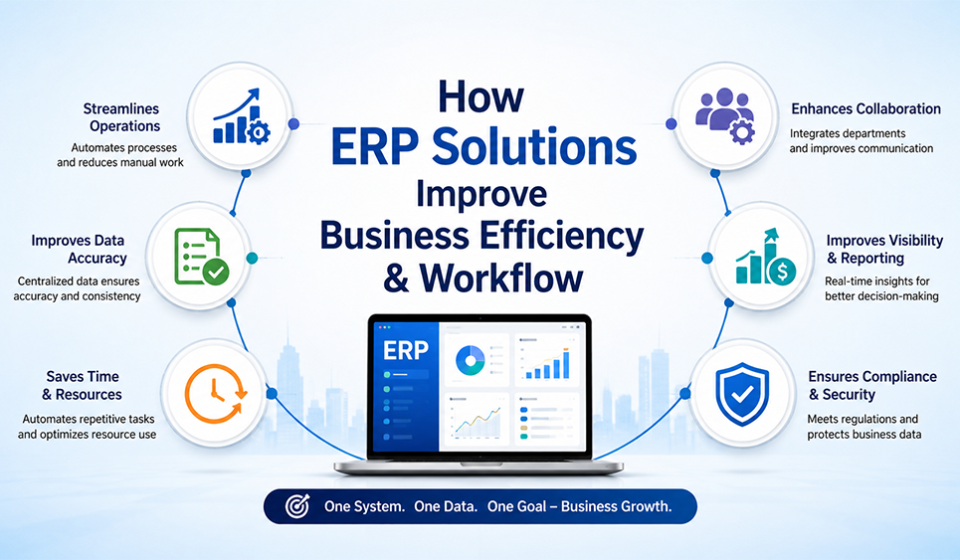
1. Centralized Data
All departments can work with the same business information.
This reduces duplicate records and inconsistent data.
2. Faster Operations
Automating repetitive tasks allows employees to focus on higher-value activities.
3. Fewer Human Errors
Manual data entry can introduce mistakes.
Automation reduces unnecessary repetitive input.
4. Better Management Visibility
Business owners and managers can monitor operations through dashboards and reports.
They can quickly understand:
- Sales performance
- Inventory levels
- Expenses
- Revenue
- Outstanding payments
- Employee activity
- Customer performance
5. Improved Customer Experience
Automation can make customer interactions faster.
For example, customers can automatically receive:
- Order confirmations
- Payment notifications
- Shipping updates
- Delivery notifications
- Invoices
6. Easier Business Scaling
A business should not need to double its administrative workload every time its customer base doubles.
Well-designed software allows businesses to handle increasing workloads more efficiently.
ERP Doesn't Have to Mean One Huge System
One common misconception is that ERP implementation always means purchasing a massive enterprise platform.
Modern businesses can start small.
For example:
Phase 1: Sales + Inventory
Phase 2: Purchase + Accounting
Phase 3: CRM + HR
Phase 4: Advanced Reporting + Automation
Phase 5: Integrations + AI-powered features
This approach allows companies to build their technology platform gradually.
Custom ERP vs Generic ERP
Generic ERP software provides predefined workflows.
That can be useful for businesses with standard processes.
However, companies with unique requirements may benefit from custom ERP development.
A custom ERP can be designed around:
- Your business rules
- Your approval processes
- Your employee roles
- Your inventory structure
- Your reporting requirements
- Your integrations
- Your future expansion plans
Technology Behind Modern Business Systems
A scalable ERP or business automation platform may use technologies such as Laravel, React, Node.js, PostgreSQL, MySQL, Redis, Docker, cloud infrastructure, APIs, and modern authentication technologies.
The technology stack should ultimately be selected based on the project's requirements—not simply because a particular technology is popular.
Build Your Business Around Better Systems
At Code Witchers, we develop custom software and ERP solutions designed around real business processes.
Our development workflow covers planning, UI/UX design, development, testing, deployment, and ongoing maintenance.
We focus on creating systems that are scalable, secure, maintainable, and capable of evolving with the business.
Final Thoughts
Business growth should not mean increasing operational complexity.
The right software can connect departments, automate repetitive tasks, centralize data, improve decision-making, and help organizations scale more efficiently.
If your business is currently managing important operations through spreadsheets, disconnected applications, or manual processes, it may be time to consider a centralized business management system.
Automate your operations. Centralize your data. Build a smarter business with Code Witchers.